
Are random number generators really random, or do they merely create results that look unpredictable? The answer depends on the technology behind them. Most computers use mathematical instructions to produce sequences called pseudorandom numbers. These numbers can appear random during everyday use, but they ultimately come from a repeatable process. Other systems collect unpredictable physical events, such as electrical noise, to generate what experts call true random numbers. This difference matters because randomness supports secure passwords, encrypted messages, scientific simulations, online games, lotteries, and many other digital services. A weak generator can introduce bias, make outcomes predictable, or create serious security risks. This article explains what randomness means, how different generators work, where they are used, and why some methods are more trustworthy than others. You will also learn how generators are tested, which mistakes to avoid, and how to choose the right type for a practical task.
What Random Number Generators Really Do
A random number generator produces values from a defined range while attempting to make each valid result unpredictable. However, unpredictable output does not always come from a genuinely random source.
In ordinary conversation, random means that no obvious pattern or plan controls an outcome. In computing, the idea is more precise. A useful random sequence should avoid meaningful patterns, distribute results fairly, and prevent an observer from predicting the next value.
Computers are designed to follow instructions exactly. Give a standard program the same input and it normally returns the same output. This predictable behavior makes computers reliable, but it also makes true randomness difficult to create with software alone.
Most programs solve this problem by using a deterministic algorithm that produces convincing, irregular-looking values. These results are pseudorandom because a mathematical process creates them, even when users cannot easily identify the process or predict its output.
True random generators take a different approach. They measure physical activity that is naturally difficult to predict, such as thermal noise, radioactive decay, or variations in electronic circuits. The measurements are processed and converted into usable random bits.
Therefore, the honest answer is that some random number generators are genuinely based on physical uncertainty, while many are not. A generator can still be useful and secure without being truly random, provided its design matches the intended purpose.
Main Types Of Random Number Generators
Random generators can be grouped by where their unpredictability comes from and how their results are produced.
1. Pseudorandom Number Generators
A pseudorandom number generator uses an algorithm and an initial value called a seed. It produces a sequence that appears irregular but is completely determined by that seed. Reusing the seed and algorithm recreates exactly the same sequence, which can be helpful for testing and simulations.
2. Cryptographic Random Number Generators
A cryptographically secure pseudorandom number generator is designed to resist prediction. Even if an attacker sees part of its output, discovering earlier or future values should remain impractical. These generators combine strong algorithms with carefully collected entropy and are commonly used for passwords, tokens, and encryption keys.
3. Hardware Random Number Generators
Hardware random number generators measure physical processes inside specialized electronic components. They may observe circuit noise, timing variations, or other unstable signals. Properly designed hardware can provide strong entropy, although its output still needs monitoring and processing to remove faults or unwanted bias.
4. True Random Number Generators
A true random number generator relies on a nondeterministic physical phenomenon rather than a fixed mathematical sequence. Its results cannot simply be reproduced by supplying the same seed. These systems are valuable when high-quality unpredictability matters, but they may be slower and more expensive than software alternatives.
5. Quantum Random Number Generators
Quantum generators use measurements of quantum events, such as the path taken by a photon. Quantum theory treats certain measurement outcomes as fundamentally uncertain rather than merely difficult to calculate. These devices can supply strong randomness, although the surrounding hardware and processing still require careful validation.
6. Human Generated Random Values
People sometimes generate numbers by choosing them, rolling dice, shuffling cards, or recording keyboard and mouse activity. Physical tools may provide useful randomness when handled correctly. Direct human choices are usually poor sources because people favor certain numbers and unconsciously create recognizable patterns.
How Pseudorandom Number Generation Works
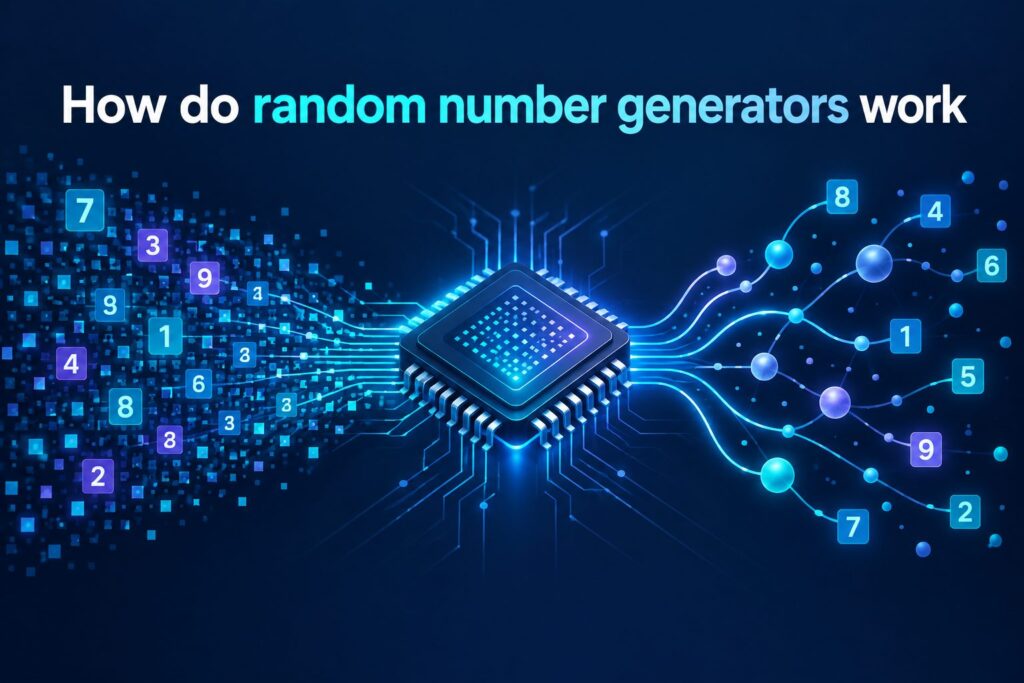
A pseudorandom generator turns a small starting value into a much longer sequence through a repeatable process. The basic workflow is straightforward.
- Select An Algorithm: A program chooses a mathematical generator suited to its purpose, whether that is a fast simulation, a game, or a security-sensitive operation.
- Obtain A Seed: The generator receives a starting value from a clock, operating system, hardware source, saved setting, or another input.
- Create An Internal State: The algorithm converts the seed into stored information that represents its current position in the sequence.
- Calculate The Next Value: A defined mathematical operation changes the internal state and produces one or more output bits.
- Map The Result: The program converts the raw output into the required range, such as a number from one to six.
- Update The State: The altered state becomes the input for the next calculation, allowing the sequence to continue without restarting.
- Repeat As Needed: Each request advances the generator until the program ends, reseeds the system, or reaches the algorithm’s repetition limit.
How True Random Numbers Are Created
True random systems obtain uncertainty from measurable events in the physical world rather than relying only on mathematical instructions.
1. Measuring Electronic Noise
Electronic components naturally produce small voltage fluctuations caused by thermal and physical effects. Sensitive hardware can measure these changes and translate them into digital values. Because ordinary software does not control the fluctuations, they can supply useful entropy for a random generation system.
2. Observing Radioactive Decay
The exact moment when an unstable atom decays cannot be reliably predicted. A detector can record the timing of decay events and convert those observations into random bits. This method offers a strong physical foundation, although it requires specialized equipment and careful handling.
3. Recording Photon Behavior
Optical devices can send individual photons toward components that provide multiple possible paths. Detectors record the resulting outcomes as zeros and ones. The quantum nature of the measurement provides uncertainty, while calibration helps prevent equipment differences from favoring one result over another.
4. Collecting Timing Variations
Physical systems contain tiny timing changes known as jitter. These variations may appear in oscillators, processors, network events, or user input. A generator can sample the least predictable parts of that timing, although it must separate genuine entropy from predictable environmental influences.
5. Removing Bias From Measurements
Raw physical data is rarely perfect. A sensor may produce slightly more zeros than ones or develop correlations between measurements. Randomness extraction and conditioning processes transform this uneven input into a more balanced output without pretending that weak source data contains more entropy than it does.
6. Monitoring The Entropy Source
A physical generator may fail because of aging components, interference, temperature changes, or deliberate manipulation. Reliable systems run continuous health checks that detect unusual patterns, repeated values, and sensor failures. Monitoring prevents defective physical output from being accepted as trustworthy randomness.
True Random And Pseudorandom Numbers Compared
Both approaches can produce useful results, but their differences determine which one is appropriate for a particular task.
1. Source Of Uncertainty
True random generators obtain uncertainty from physical events, while pseudorandom generators expand a seed through deterministic calculations. This distinction describes how the values originate. It does not automatically mean that every physical generator is reliable or that every algorithmic generator is unsuitable.
2. Ability To Reproduce Results
Pseudorandom sequences can be recreated when the same algorithm, seed, and settings are available. True random observations generally cannot be repeated. Reproducibility is valuable in scientific debugging and software testing because researchers can investigate an identical sequence after discovering an unexpected result.
3. Generation Speed
Software algorithms can produce large quantities of pseudorandom data very quickly. Physical generators are often limited by measurement rates, sensor performance, and processing requirements. Many practical systems collect a smaller amount of physical entropy and use it to seed a fast cryptographic generator.
4. Predictability And Security
A basic pseudorandom generator may become predictable if someone discovers its seed or internal state. A cryptographically secure design makes that prediction computationally impractical. Physical randomness can strengthen security, but faulty sensors, biased output, and insecure implementation can still weaken the finished system.
5. Cost And Complexity
General-purpose pseudorandom generators require no dedicated measuring equipment and are easy to include in software. True random systems may need specialized hardware, calibration, testing, and fault detection. The additional complexity is justified only when a task benefits from independently collected physical entropy.
6. Suitability For Different Tasks
Simulations often need fast, repeatable pseudorandom sequences, while security applications need unpredictable cryptographic output. Lotteries and high-assurance systems may benefit from physical sources and independent auditing. Choosing correctly depends on the consequences of prediction, bias, failure, and inability to reproduce results.
Why High Quality Randomness Matters
Poor randomness can affect fairness, security, accuracy, and trust across many systems.
- Secure Encryption: Unpredictable keys prevent attackers from narrowing the possibilities and recovering protected information.
- Fair Outcomes: Games, drawings, and selections require balanced results that do not favor particular participants or values.
- Reliable Research: Scientific sampling and simulations depend on sequences that do not introduce hidden patterns into results.
- Protected Accounts: Random session identifiers, recovery codes, and temporary tokens reduce the chance of unauthorized access.
- Accurate Statistics: Representative random samples help researchers reduce selection bias and make stronger conclusions about populations.
- Public Confidence: Documented generation methods and independent testing help people trust systems whose decisions affect them.
Practical Uses For Random Number Generators
Random generation supports routine digital features as well as specialized scientific and security work.
1. Passwords And Encryption Keys
Security software uses random data to create encryption keys, initialization values, salts, and recovery codes. These values must be difficult for an attacker to guess. A predictable generator can undermine strong encryption because the attacker may reconstruct the secret inputs instead of breaking the encryption itself.
2. Games And Virtual Worlds
Games use random numbers for shuffled cards, item drops, enemy behavior, procedural maps, and uncertain outcomes. Developers generally choose fast pseudorandom generators because games request many values. Competitive systems may also protect seeds and server-side logic to discourage cheating and outcome manipulation.
3. Scientific Simulations
Researchers use pseudorandom sequences to model weather, particles, financial risk, disease spread, and other complex systems. Repeatable seeds let teams verify results and compare methods. The generator must have suitable statistical properties so hidden correlations do not distort the simulated behavior.
4. Statistical Sampling
Random selection helps researchers choose survey respondents, medical study groups, products for inspection, or records for auditing. A sound selection process gives eligible items a fair chance of inclusion. Poor implementation can create sampling bias even when a random function is technically involved.
5. Online Lotteries And Drawings
Digital drawings need transparent rules, balanced selection, protected inputs, and verifiable procedures. Using a random generator alone does not prove fairness. Operators must also control who enters, when the draw occurs, how the seed is created, and whether anyone can alter the result.
6. Machine Learning And Testing
Machine learning systems use randomness when dividing datasets, initializing model parameters, and selecting training examples. Software testers generate varied inputs to discover failures that fixed examples may miss. Saved seeds make an interesting failure reproducible, allowing developers to diagnose and correct the underlying problem.
Common Random Number Generator Mistakes
Most failures come from selecting, seeding, or applying a generator incorrectly rather than from randomness as a concept.
1. Using A Basic Generator For Security
A generator designed for games or simulations should not create passwords, authentication tokens, or encryption keys. Its output may be statistically convincing yet predictable after limited observation. Security-sensitive work should use the operating system’s approved cryptographic random service or another carefully reviewed secure generator.
2. Choosing A Predictable Seed
Seeding a generator with the current time may produce only a small set of realistic starting values. An attacker who knows approximately when the program ran can test those possibilities. Secure seeds need sufficient entropy collected from sources the attacker cannot easily observe or reproduce.
3. Reusing Seeds Without Intention
Repeated seeds create repeated sequences. That behavior is useful in controlled experiments but dangerous when systems expect fresh secrets or independent outcomes. Developers should decide explicitly whether reproducibility is required and document seed handling so test settings do not accidentally reach a production environment.
4. Creating Biased Number Ranges
A common shortcut applies a remainder operation to fit raw output into a smaller range. If the original range does not divide evenly, some results occur more often. Rejection sampling or a trusted range function can produce a more balanced distribution without this subtle mathematical bias.
5. Trusting Visual Inspection
People are poor judges of randomness. A sequence containing clusters or repeated values may look suspicious even though such events occur naturally. Conversely, an orderly-looking sample may hide predictable structure. Evaluation requires appropriate statistical tests, design review, and security analysis rather than visual impressions alone.
6. Ignoring Hardware Failure
A physical source does not guarantee permanent quality. Sensors can become stuck, environmental conditions can change, and malicious interference may affect measurements. Hardware generators need startup checks, continuous monitoring, secure conditioning, and a defined response that stops or limits output when failures are detected.
Best Practices For Reliable Random Generation
Good results depend on matching the generator to the task and protecting the entire generation process.
1. Define The Required Level Of Randomness
Begin by identifying what failure would mean. A classroom game, repeatable simulation, public drawing, and encryption system have different risks. Clarifying the required speed, reproducibility, fairness, and resistance to attack helps prevent both weak choices and unnecessary technical complexity.
2. Use Trusted System Tools
Modern operating systems provide cryptographic random services that collect entropy and manage internal state. Applications should normally use these established facilities rather than inventing a custom generator. Mature tools receive wider review, handle platform differences, and reduce the chance of subtle implementation errors.
3. Protect Seeds And Internal State
For a cryptographic generator, the seed and internal state can be as sensitive as the output. Store them carefully, limit access, and avoid exposing them through logs or error messages. When appropriate, refresh the state with new entropy to limit damage from compromise.
4. Preserve Seeds For Repeatable Research
Scientific and testing workflows often benefit from storing the seed with experiment settings and software versions. This practice allows another person to reproduce a sequence and investigate unexpected behavior. The rule differs from security work, where publicly recording a seed may destroy the required unpredictability.
5. Test The Complete Implementation
Testing should cover more than the core algorithm. Review entropy collection, seed creation, range conversion, concurrency, storage, error handling, and deployment settings. A strong generator can still produce weak outcomes when supporting code truncates values, repeats state, or handles failures incorrectly.
6. Document And Review The Design
Record which generator is used, why it suits the task, where entropy comes from, and how failures are managed. Independent review is especially valuable for security, gambling, lotteries, and regulated applications. Clear documentation also prevents later maintenance work from weakening important assumptions.
How Randomness Is Tested
Randomness testing looks for evidence of bias, dependence, repetition, or implementation failure, but no single test can prove that a sequence is truly random.
Frequency tests check whether expected values appear at roughly balanced rates. For binary output, that may mean comparing the number of zeros and ones. Large or persistent differences can reveal bias, although small differences are normal in finite samples.
Sequence tests examine runs, repeated blocks, correlations, and relationships between nearby outputs. A generator may pass a simple frequency test while still producing values in a predictable order, so several complementary tests are usually needed.
Security evaluation asks a different question. It considers whether an attacker can infer the seed, recover internal state, predict future output, or reconstruct earlier values. Passing statistical tests does not make a generator cryptographically secure because a deterministic sequence can look statistically excellent.
Physical generators also require health testing. Engineers monitor the raw entropy source, conditioned output, environmental behavior, and failure modes. Testing must detect stuck sensors and gradual degradation without rejecting ordinary clusters that legitimate randomness naturally produces.
The strongest assessment combines statistical evidence, technical review, threat analysis, operational monitoring, and transparent documentation. Tests can reveal weaknesses and increase confidence, but the generator’s design and entropy source remain essential parts of the evaluation.
Frequently Asked Questions
1. Can A Computer Generate A Truly Random Number?
A standard deterministic program cannot create true randomness from nothing because identical inputs produce identical outputs. However, a computer can collect unpredictable physical measurements from hardware and convert them into random numbers. Most devices combine collected entropy with efficient cryptographic algorithms to serve applications safely.
2. Why Are Pseudorandom Numbers Useful?
Pseudorandom numbers are fast, convenient, and capable of producing long sequences with useful statistical properties. They can also be reproduced by saving a seed, which is valuable for simulations, research, and debugging. Strong cryptographic versions provide practical unpredictability for many security applications.
3. Can Someone Predict A Random Number Generator?
Prediction may be possible when the generator uses a weak algorithm, a guessable seed, exposed internal state, or flawed implementation. A properly operated cryptographic generator is designed to make prediction impractical. Physical sources add entropy but still need secure processing, monitoring, and protection.
4. Are Online Random Number Generators Trustworthy?
Trust depends on the provider, purpose, implementation, and level of verification available. A simple online tool may be adequate for casual choices but unsuitable for secrets or valuable drawings. Sensitive applications should use trusted local cryptographic services and independently reviewed procedures rather than unknown websites.
5. Does A Repeated Number Mean The Generator Is Broken?
No. Genuine randomness naturally includes repetitions, streaks, and clusters. Preventing a recent value from appearing again can actually make output less random. Concern is justified when repetition becomes statistically unusual, follows a detectable pattern, or results from a stuck state or hardware fault.
6. Is Quantum Randomness Better Than Pseudorandomness?
Quantum randomness offers a strong physical source, but it is not automatically the best choice for every application. It may add cost, complexity, and limited generation speed. A trusted cryptographic generator is often sufficient, while quantum hardware suits situations requiring independently measured physical entropy.
Conclusion
Random number generators are not all random in the same way. Most software uses deterministic pseudorandom algorithms, while true random systems measure uncertain physical events. Both approaches can be reliable when their algorithms, entropy sources, seeds, range handling, and operational controls are appropriate for the task.
The practical question is not simply whether a generator is truly random. It is whether its output is unbiased, unpredictable, reproducible when necessary, and resistant to the risks of its intended use. Matching the method to the purpose, using trusted tools, and testing the complete implementation provides the strongest foundation for dependable randomness.


Discussion