
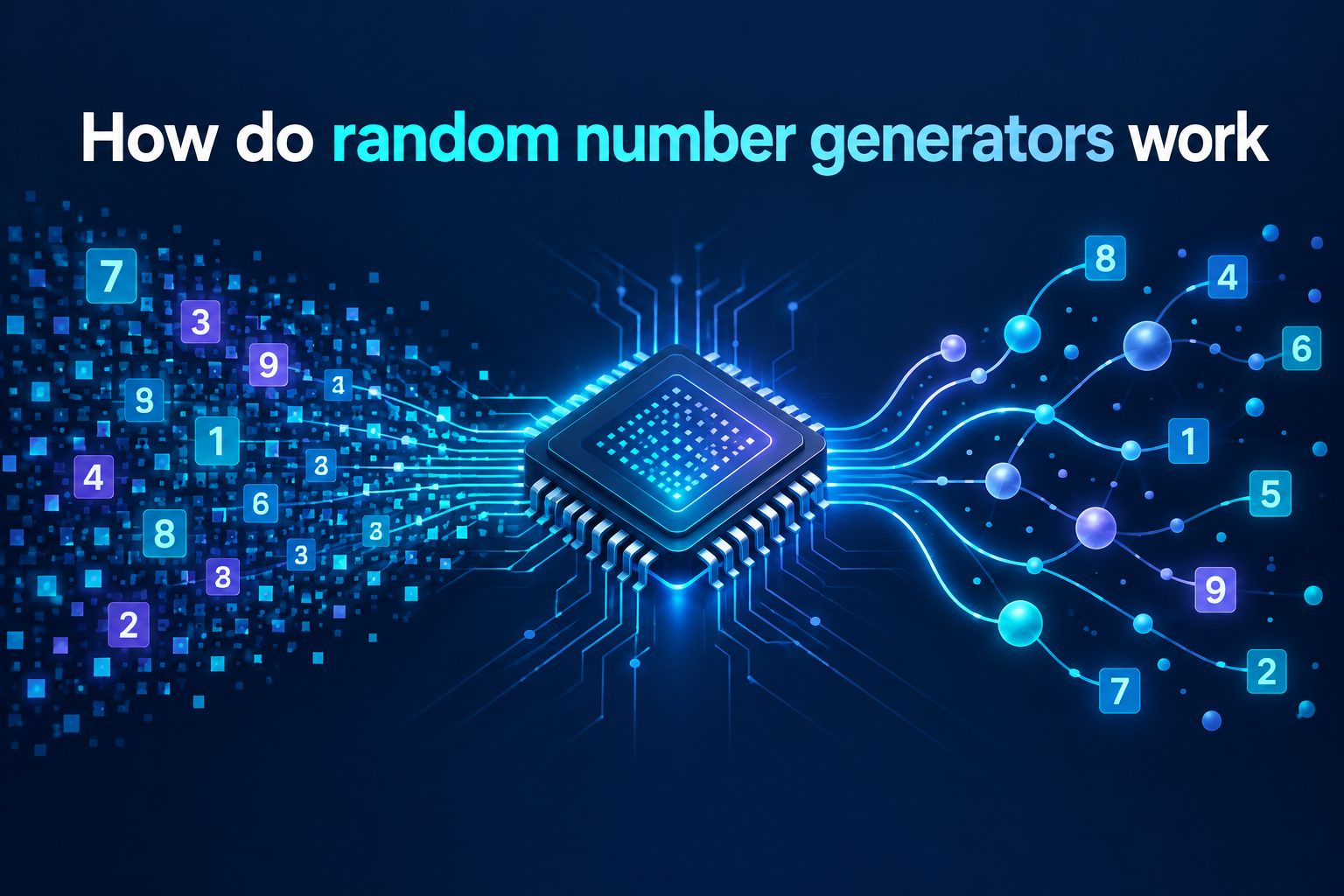
Random number generators are tools that produce values that appear unpredictable, such as numbers, symbols, or selections from a defined range. They are used in games, scientific research, online security, statistics, lotteries, simulations, programming, and everyday decision-making. Although the result may look completely random, the way it is created depends on the type of generator being used. Some generators rely on mathematical formulas, while others measure unpredictable physical events such as electrical noise or radioactive decay. This article explains how random number generators work, why randomness matters, how pseudorandom and true random systems differ, and where each type is useful. You will also learn how computers create random-looking results, why seeds are important, what makes a generator secure, which mistakes to avoid, and how to choose the right method for a particular task.
What Random Number Generators Do
A random number generator creates values without following an obvious pattern to the person using it. The output might be an integer between one and one hundred, a decimal between zero and one, a random password character, or a selection from a list. The generator follows instructions that define the possible results and the probability of each result.
The word “random” can mean slightly different things depending on the situation. In a simple game, random may mean that each result is difficult to predict. In scientific research, it may mean that every outcome has a known probability. In cybersecurity, randomness must also resist prediction by an attacker who studies previous outputs.
The generator usually starts with an internal process, produces a raw value, and then converts that value into the format requested by an application. For example, a system may collect random bits, combine them mathematically, and use the result to select a number from one through ten.
1. Producing An Unpredictable Result
The central purpose of a random number generator is to make the next result difficult to determine. A person should not be able to look at several earlier results and reliably calculate what comes next. This unpredictability supports fair games, unbiased samples, secure encryption keys, and realistic computer simulations.
2. Defining The Possible Range
A generator must know which values it is allowed to produce. A request may specify whole numbers from one to six, decimal values from zero to one, or a fixed number of random bits. The range is important because it affects both the output format and the probability of every possible result.
3. Assigning Probabilities
Many generators are designed so that every result has an equal chance. For example, a fair six-sided die should give each side a probability of one in six. Other systems intentionally use different probabilities, such as a simulation that makes rare events less common than ordinary events.
4. Converting Raw Data
Random systems often produce raw binary information rather than the final number a user sees. Software converts those bits into integers, decimals, letters, colors, or selections. A careful conversion method is needed so that some results are not accidentally favored over others.
5. Repeating The Process
Most generators can produce a long stream of results quickly. Each new value is created from the generator’s internal state or from a fresh physical measurement. Applications can request one result, thousands of results, or a continuous stream for a simulation or online service.
6. Testing The Output
A generator can appear random while still containing hidden bias. Testing checks whether results have unusual patterns, repeated structures, uneven frequencies, or correlations between values. Statistical tests do not prove perfect randomness, but they can reveal serious weaknesses in a design.
Pseudorandom Number Generators
A pseudorandom number generator, often called a PRNG, uses an algorithm to create a sequence of values that looks random. Because the algorithm is deterministic, the same starting condition produces the same sequence. This predictable foundation sounds like a weakness, but it is extremely useful for software, testing, games, and simulations.
The generator begins with a starting value called a seed. It applies a mathematical rule to that seed, produces an output, updates its internal state, and then repeats the process. Modern PRNGs can create very long sequences before the pattern repeats, and the repetition point is called the period.
1. The Role Of A Seed
A seed determines where the sequence begins. If two programs use the same algorithm and the same seed, they normally produce the same results in the same order. This is useful when researchers need to reproduce an experiment or developers need to recreate a software bug.
2. The Internal State
The internal state contains information used to calculate the next value. A stronger generator maintains a large and complex state, making it harder to infer from a small number of outputs. Once the state is exposed, however, some algorithms can become predictable.
3. Mathematical Recurrence
A PRNG repeatedly applies a mathematical relationship to its current state. Some older generators use simple arithmetic, while modern designs use more sophisticated transformations. The quality of the recurrence determines the sequence’s period, distribution, speed, and resistance to prediction.
4. Speed And Efficiency
Because pseudorandom generation uses calculations rather than physical measurements, it is fast and inexpensive. A computer can create millions of values in a short time. This makes PRNGs ideal for animations, game mechanics, randomized testing, and large statistical models.
5. Reproducible Results
Reproducibility is one of the main advantages of a PRNG. A researcher can save the seed and repeat the same simulation later. Developers can use a fixed seed during testing to make a random process behave consistently while they investigate a problem.
6. The Limits Of Predictability
A PRNG is not automatically suitable for security. If an attacker identifies the algorithm and discovers enough information about the internal state, future values may be predicted. A generator intended for passwords, tokens, or encryption must be designed specifically for cryptographic security.
True Random Number Generators
A true random number generator, or TRNG, obtains randomness from a physical process that is difficult to predict. Examples include atmospheric noise, electronic circuit noise, timing variations, thermal activity, and other microscopic events. The device measures this source and converts the measurement into random bits.
Unlike a basic PRNG, a TRNG does not create its entire sequence from a reusable mathematical starting point. Its output depends on ongoing physical conditions. However, physical randomness can be affected by interference, hardware failure, or environmental changes, so the raw data often needs conditioning and health checks.
1. Physical Noise Sources
A TRNG may measure unpredictable changes in voltage, temperature, timing, or electromagnetic activity. The important quality is not that the process looks complicated, but that its outcome cannot be practically predicted. The source must also be stable enough for a device to measure accurately.
2. Entropy And Uncertainty
In this context, entropy describes the amount of uncertainty available in a source. A source with high entropy can provide many unpredictable bits. A source with low entropy may appear varied but contain patterns that reduce the true amount of randomness available.
3. Sampling The Source
The device takes measurements at carefully chosen times or intervals. Poor sampling can introduce patterns, especially if the source fluctuates in a regular way. Engineers analyze the source and select a sampling method that captures unpredictable variation rather than predictable behavior.
4. Conditioning Raw Bits
Raw physical measurements may contain bias or unequal probabilities. Conditioning processes mix and transform the data to produce a more balanced output. This step does not create randomness from nothing, but it can remove unwanted structure and improve the usability of the collected entropy.
5. Health Monitoring
A reliable TRNG continually checks whether its physical source is working properly. If a circuit becomes stuck, overheats, or begins producing repeated values, the system should detect the problem and stop presenting the output as trustworthy randomness.
6. Combining Physical And Mathematical Methods
Many practical systems combine a physical entropy source with a secure PRNG. The physical source supplies unpredictable seed material, while the algorithm expands that material quickly into a large stream. This approach balances strong unpredictability with high performance.
How Computers Create Random Numbers
Computers are built to follow instructions, so they do not naturally create randomness in the same way physical systems do. Software usually requests randomness from an operating system service. The operating system gathers entropy from approved sources, maintains a random pool, and supplies values to applications.
Sources may include hardware random instructions, timing differences, device activity, network events, and other system behavior. The operating system combines these inputs rather than relying on one measurement. When an application asks for random data, the system uses a suitable generator and returns the requested number of bytes.
1. Gathering Entropy
The operating system collects unpredictable information from multiple sources. Individual events may be weak or biased, but combining many independent events can produce a stronger pool. The system continuously updates this pool as new information becomes available.
2. Initializing The Generator
Before producing secure values, the generator must be initialized with enough unpredictable data. This process is often called seeding. If a system starts with insufficient entropy, early outputs may be weaker than later outputs, especially during startup or on a newly created virtual machine.
3. Expanding Randomness
A secure generator uses a small amount of high-quality entropy to create a much larger stream of random-looking data. Its algorithm is designed so that observing outputs does not reveal the internal state or allow practical prediction of future values.
4. Serving Applications
Applications typically request random bytes rather than managing the physical entropy source themselves. This central service prevents every program from making its own flawed random system. It also allows the operating system to apply safeguards and updates consistently.
5. Handling Reseeding
A secure system periodically refreshes its internal state with new entropy. Reseeding limits the damage that could result if an attacker temporarily observed part of the generator’s state. The exact process varies by operating system and security design.
6. Protecting The Internal State
The internal state must remain confidential. If an attacker learns it, they may be able to reconstruct previous or future outputs, depending on the generator’s design. Secure implementations use state protection, recovery mechanisms, and careful memory handling to reduce this risk.
Common Uses Of Random Number Generators
Random number generators appear in more places than many people realize. They help computers make fair selections, create varied environments, protect accounts, and model uncertain events. The required level of randomness depends on the consequences of failure.
A casual game may only need a fast generator that produces convincing variation. A banking system needs a security-focused generator because predictable values could expose accounts or transactions. Scientific software may prioritize reproducibility, while a lottery system may require independently tested hardware and strict auditing.
1. Games And Entertainment
Video games use random numbers to determine item drops, enemy behavior, map layouts, card draws, and event timing. Most games use pseudorandom systems because they need speed and may benefit from repeatable seeds for saved games, testing, or replay features.
2. Online Security
Secure random values are used for passwords, session identifiers, authentication codes, encryption keys, and account recovery tokens. These applications require cryptographically secure generation because an attacker who predicts the value may gain unauthorized access.
3. Scientific Simulations
Researchers use random sampling to model weather, financial risk, population changes, molecular behavior, and many other systems. A reproducible PRNG allows the same experiment to be repeated, while a carefully selected distribution helps the simulation reflect real-world conditions.
4. Statistics And Surveys
Random selection helps researchers reduce sampling bias. A survey that chooses participants randomly can provide a more representative picture than one that relies only on volunteers. The generator must be used correctly, because a flawed selection process can still produce biased results.
5. Lotteries And Drawings
Random systems select winners in promotions, raffles, and official drawings. These uses require transparency, fairness, and often independent verification. The process should prevent organizers or participants from predicting or manipulating the result.
6. Load Testing
Developers use random inputs to test how software handles unexpected combinations. Randomized testing can reveal errors that carefully chosen examples miss. For meaningful results, teams often save the seed so that a failing test can be reproduced exactly.
Steps For Choosing The Right Generator
Selecting a random number generator begins with the consequences of an incorrect or predictable result. A simple decision tool may be appropriate for a classroom exercise, while a security-sensitive application needs a generator specifically designed to resist attacks.
1. Define The Purpose
Write down what the random values will control. Consider whether the task involves entertainment, simulation, sampling, passwords, money, access control, or legal fairness. The purpose determines the required level of security and testing.
2. Identify The Output
Decide whether you need integers, decimal values, binary data, characters, shuffled items, or weighted choices. Different outputs require different conversion methods, and careless conversion can create uneven probabilities.
3. Assess Predictability Risks
Ask what could happen if someone predicted the next result. If prediction would expose an account, reveal a secret, manipulate a contest, or affect financial outcomes, use a cryptographically secure source.
4. Choose Reproducibility Or Freshness
Scientific experiments and software tests often benefit from repeatable sequences. Security systems generally need fresh, unpredictable values. These goals are different, so do not use the same generator configuration for both without careful review.
5. Check Distribution Requirements
A generator may need equal probabilities or a custom distribution. Confirm that the method matches the intended model. For example, selecting a random number and applying a simple remainder operation can favor some outcomes when the range does not divide evenly.
6. Review The Implementation
Use a trusted library or operating system service rather than writing a generator from scratch. Check how it is seeded, how it handles ranges, and whether it is intended for security, simulation, or general-purpose use.
7. Test Real Outputs
Run statistical and functional tests appropriate to the application. Look for bias, repeated values, unexpected correlations, and failures under load. Testing cannot prove absolute randomness, but it can expose design mistakes and implementation bugs.
Benefits And Limitations Of Random Number Generators
Random number generators make software more flexible and help people make impartial decisions. They can also create a false sense of confidence when users assume every generator is secure or perfectly fair. Understanding both benefits and limitations leads to better choices.
1. Fairness
Random selection can reduce personal bias when choosing participants, winners, samples, or tasks. Fairness still depends on correct setup, equal probabilities, and protection against interference.
2. Efficiency
A computer can generate large quantities of random data quickly. This supports simulations, testing, games, and automated decisions that would be impractical to perform manually.
3. Reproducibility
Pseudorandom systems allow an experiment or test to be repeated exactly. This is valuable for research and debugging, but reproducibility must not replace unpredictability when secrets are involved.
4. Flexibility
Generators can create numbers, letters, colors, positions, schedules, and weighted choices. The same underlying system can support many different applications when the output is converted properly.
5. Hidden Bias
A flawed algorithm, poor seed, biased source, or incorrect range conversion can make some results more likely than others. A result may look random while still being statistically unfair.
6. Security Weaknesses
General-purpose generators may be predictable. Using them for passwords, tokens, or encryption can create serious vulnerabilities. Security requires a generator with appropriate resistance to state recovery and prediction.
7. Resource Dependence
True random systems depend on physical hardware and reliable entropy sources. Hardware failure, poor initialization, or environmental interference can reduce quality unless the system includes monitoring and fallback protection.
Common Random Number Generator Mistakes
Mistakes often happen when people focus only on whether the output looks random. A strong implementation must also consider seeding, probability, security, range handling, and reproducibility.
1. Using A Basic Generator For Security
A fast general-purpose PRNG may be suitable for a game but unsafe for authentication tokens. If an attacker can infer the seed or state, future values may become predictable. Use a cryptographically secure source for every security-sensitive purpose.
2. Choosing Predictable Seeds
Seeding a generator with the current time is convenient but often weak. If an attacker knows approximately when a value was created, the possible seeds may be easy to guess. Secure systems gather seed material from multiple unpredictable sources.
3. Creating Biased Ranges
Taking a random integer and applying a remainder operation can cause uneven results when the source range does not divide evenly by the requested range. Use a library method that applies rejection sampling or another unbiased conversion technique.
4. Assuming A Random-Looking Pattern Is Proof
Short sequences can contain repeats, clusters, or runs by chance. Conversely, a sequence can look varied while containing hidden bias. Evaluate the generator with suitable tests instead of judging it by appearance alone.
5. Ignoring Reproducibility
When a randomized test fails, developers need to recreate the same conditions. If the seed is not recorded, the problem may disappear before it can be investigated. Save seeds and relevant generator settings during testing.
6. Mixing Insecure And Secure Data
Combining a secure value with predictable or low-quality data does not automatically create a secure result. The design must use established algorithms and trusted libraries. Randomness quality depends on the complete process, not one ingredient.
Best Practices For Reliable Randomness
Good random number generation is mostly about matching the method to the task and avoiding unnecessary custom design. The following practices help maintain fairness, security, and dependable results.
1. Use Established Libraries
Well-maintained libraries have already handled common problems such as seeding, range conversion, state management, and platform differences. Writing a custom generator adds risk unless you have specialized expertise and a clear reason.
2. Separate Security And Simulation
Use a cryptographically secure generator for secrets and a reproducible PRNG for simulations or tests. Keeping these purposes separate makes the code easier to review and prevents accidental reuse of an unsuitable generator.
3. Record Seeds During Testing
Save the seed, input data, generator type, and relevant configuration whenever a randomized test runs. This creates a path back to the exact failing case and improves debugging efficiency.
4. Avoid Manual Randomness
Humans are poor at creating random sequences. People tend to avoid repeats and distribute values too evenly. Use a tested generator instead of selecting values by intuition or manually arranging a list.
5. Check Probability Assumptions
Confirm that the application’s definition of fairness matches the generator’s behavior. Verify whether values are inclusive or exclusive at the range boundaries, and ensure weighted outcomes use the intended probabilities.
6. Monitor Security Updates
Randomness libraries and operating systems may receive improvements or security fixes. Keep dependencies updated and review changes that affect entropy collection, generator algorithms, or cryptographic services.
Examples Of Random Number Generation
Real examples show why the same basic idea can require different technical choices. The important question is not simply whether the result is random, but what the result is being used for.
1. Rolling A Digital Die
A board game can request a uniformly distributed integer from one through six. A normal PRNG is usually sufficient because the main goal is fair-looking gameplay, not protection of secret information.
2. Generating A Password Reset Token
A reset token must be difficult to guess. The application should request cryptographically secure random bytes, convert them into a suitable representation, set an expiration time, and invalidate the token after use.
3. Simulating Investment Outcomes
A financial model may generate thousands of possible market scenarios. A reproducible PRNG allows analysts to compare changes in the model while holding the random sequence constant during testing.
4. Selecting Survey Participants
A research team can assign each eligible person a random value and select the smallest values or use a random sampling method. The process must ensure that every eligible participant has the intended chance of selection.
5. Shuffling A Playlist
A playlist shuffle should avoid favoring songs based on their original positions. A properly implemented shuffle uses random choices without repeatedly selecting the same item or creating an uneven distribution.
6. Testing Input Validation
A testing system can generate random strings, numbers, and symbols to find unexpected behavior. Saving the seed allows developers to repeat the exact input sequence after discovering a failure.
Frequently Asked Questions
1. Are Random Number Generators Truly Random?
It depends on the type. Pseudorandom generators use deterministic algorithms, so their sequences can be reproduced if the seed and state are known. True random generators measure physical events believed to be unpredictable. Both can be useful, but they serve different purposes and require different testing.
2. Can A Random Number Generator Be Predicted?
A basic or poorly seeded generator may be predictable. A strong cryptographic generator is designed to make prediction computationally impractical, even when an attacker sees some previous outputs. Security depends on the entire implementation, including seeding, state protection, and output handling.
3. Why Do Random Results Sometimes Repeat?
Repeats are a normal part of randomness. If a result can occur independently more than once, there is no rule requiring the generator to avoid repetition. In fact, removing repeats without a clear reason may make the sequence less random or change the intended probabilities.
4. What Is A Random Seed?
A seed is starting information used by a pseudorandom generator to begin its sequence. The same seed usually produces the same sequence, which makes testing and scientific experiments reproducible. Security systems must use unpredictable seed material rather than an easily guessed value such as a timestamp.
5. Are Online Random Number Generators Safe?
Safety depends on the provider, implementation, and purpose. A simple online tool may be fine for choosing a number in a casual situation, but it should not be trusted automatically for passwords, encryption keys, financial decisions, or sensitive access tokens.
6. How Can Randomness Be Tested?
Testing can examine frequency, runs, repetition, correlations, and distribution across large samples. Security-focused systems may use specialized statistical test suites and health checks. No test proves perfect randomness, but testing can identify bias, broken hardware, poor seeding, or implementation errors.
Conclusion
Random number generators create values that appear unpredictable, but they do so through different methods. Pseudorandom generators use mathematical algorithms and seeds to produce fast, repeatable sequences, while true random generators measure unpredictable physical events. Many modern systems combine physical entropy with secure algorithms to achieve both unpredictability and efficiency.
The right choice depends on the purpose. Games and simulations may benefit from speed and reproducibility, while passwords, authentication tokens, and encryption require cryptographically secure randomness. By selecting an appropriate generator, handling ranges correctly, testing outputs, recording seeds when needed, and avoiding predictable initialization, you can use random number generation more fairly, reliably, and securely.

Discussion